
Everything Know About The Ribbon Blender
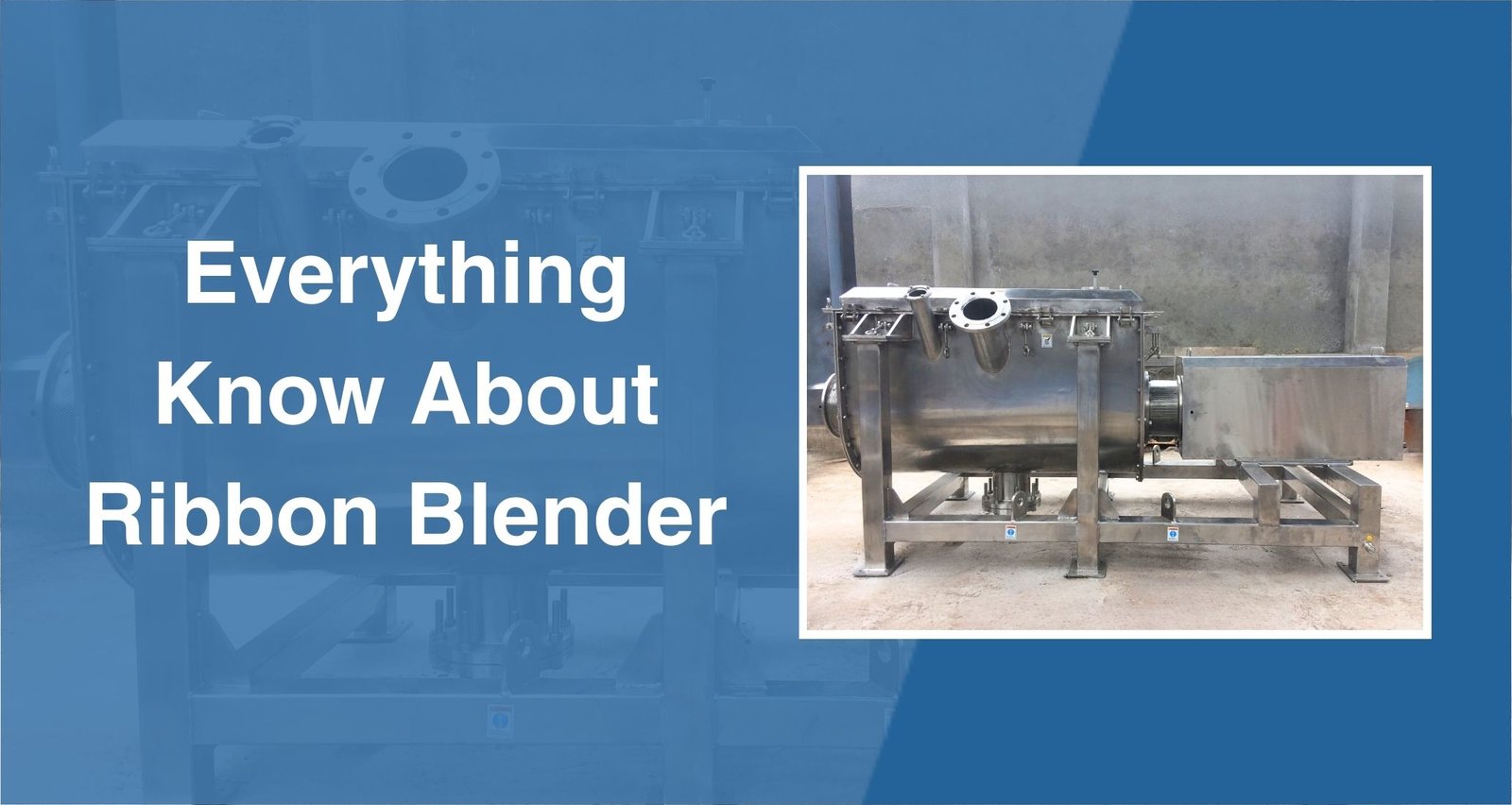
Everything You Need to Know About Ribbon Blender
Pharmaceutical manufacturers use ribbon blenders to efficiently mix dry powders, granules, pellets, and various other solid materials. Common applications of ribbon blenders in pharmaceutical manufacturing include blending polymer mixtures, composite fillers, and drug powders. When it comes to powders and bulk solids, there are very few materials that a ribbon blender cannot handle.
This versatile and highly adaptable mixing equipment, available in capacities ranging from a few cubic feet to more than 1000 cubic feet, is widely used across multiple industries for blending dry powders, granules, pellets, flakes, and other solid materials. If you are looking for a high-quality ribbon blender, you can choose Padmatech Industries Pvt. Ltd., known for delivering reliable quality at competitive pricing.
What Is a Ribbon Blender?
A ribbon blender is a light-duty mixer primarily used for simple-to-mix powder materials that are pre-processed, such as dried granules and pre-sieved powders. Solid-liquid mixing can also be achieved when high shearing force is not required.
It requires less headroom space for large-volume blending compared to Double Cone and V Blenders. Ribbon blenders are extremely versatile machines. They can also function as paste mixers, vacuum dryers, granulators, and coaters, where solid particles are evenly coated with a small amount of liquid or fine powder.
Working Principle of Ribbon Blender
The ribbon blender mixes free-flowing raw materials inside a U-shaped trough. A horizontal agitator consisting of precisely pitched inner and outer helical ribbons moves materials in both axial and radial flow patterns.
High-quality ribbon blenders feature tightly controlled clearances between the trough surfaces and agitator tips. Proper design and expert manufacturing ensure fast and repeatable mixing, easy cleaning, low maintenance, and long service life.
Due to their popularity and wide range of applications, ribbon blenders are offered by many manufacturers. It is important to select a high-quality blender suitable for your specific application and manufactured by a trusted company, as quality and performance can vary significantly between OEMs. The key is to clearly define your requirements so you can confidently choose a blender that is neither under-specified nor over-designed.
Features of Ribbon Blender Machine
Available in two shapes: U and W
- U – Low to medium volume capacity (single shaft)
- W – Large to mega volume capacity (double shaft)
- All contact parts are made of SS 316 stainless steel
- Bearings mounted outside the mixing zone to prevent cross-contamination
- Reduced material wastage due to side discharge arrangement
- Designed to meet cGMP standards
- Air purge on side entry seals for better cross-contamination control
- Continuous ribbon design for complete discharge of finished product
- Belt-driven power transmission for quieter operation and low maintenance
- Optional agitator design instead of ribbon for blending delicate materials
- Capacity available from 125 L to 8400 L (larger volumes up to 20,000 L available on request)
Standard Duty vs. Heavy Duty
Before approaching suppliers for pricing, make sure to check your product’s true bulk density as accurately as possible. While batch sizes are usually mentioned in weight, blender models are rated by volume capacity. Therefore, the ideal batch volume (not batch weight) determines the size of the blender.
Bulk density also determines the torque requirement and whether a standard or heavy-duty model is suitable. Most standard ribbon blenders can typically handle bulk densities of around 35 lb/cu ft. Heavy-duty ribbon blenders are available for denser materials.
Also, consider the maximum and minimum batch quantities that a specific model can accommodate. Optimal mixing in a ribbon blender requires a certain fill level, typically at least 30 to 40 percent of the rated volumetric capacity. Operating at very low volumes may result in insufficient contact between the agitator and the material.
Belt Drive vs. Direct Drive
Traditional ribbon blenders commonly use a belt drive system for power transmission between the motor and gearbox. This system includes belts and pulleys to achieve the required speed and torque range. Some manufacturers use chain drives instead of belts.
Modern ribbon blenders often use a gear motor, which integrates the motor and gearbox into a single compact unit. The motor’s low-inertia rotor is precisely matched with the gearbox characteristics, resulting in better performance during frequent start and stop cycles.
Ribbon blenders driven directly by a gear motor are generally preferred over belt or chain-driven systems because they require less maintenance and provide better overall efficiency. Gear motors also work effectively with electronic inverters that offer variable speed control, overload protection, and smooth start capability. Issues such as belt slippage, excessive load, and chain noise are eliminated in direct-drive ribbon blenders.
What Is the Right Discharge Valve for Your Application?
In a standard ribbon blender, the product is discharged through an outlet located at the center of the trough base. The discharge valve assembly must provide a proper seal to prevent material leakage and ensure a safe working environment.
Dust-tight slide gate valves are generally suitable for powders and other dry materials. Liquid-tight ball valves are appropriate for vacuum, pressure, and wet applications. For sensitive products that require minimal dead zones inside the trough, a flush-mounted valve or sanitary valve may be ideal.
You may also consider whether a pneumatically operated valve is required for more precise control of the discharge process.
Final Thoughts
If you are planning to purchase a ribbon blender, this guide will help you make an informed decision. Padmatech Industries provides high-quality powder processing and granulation equipment such as Ribbon Blenders, Roll Compactors, Granulators, and Sieve Shakers, designed to meet industrial performance and quality standards.